News

Marina Abramović's Slow Walking Avatar Performance Auctioned off at amfAR Venezia
The sale breaks the market record for the artist's work.
TAEX is pleased to announce the sale of Slow Walking (2026), a limited-edition avatar performance by Marina Abramović powered by TAEX, to a private collector for €500,000 at amfAR Venezia. Presented at amfAR Venezia on 6 September 2026, during the 83rd Venice International Film Festival, Slow Walking drew undeniable attention, as the evening also honoured Marina Abramović with amfAR’s Award of Inspiration, recognising her extraordinary cultural influence and enduring commitment to expanding the physical, emotional and spiritual possibilities of art. The acquisition establishes a new market milestone for Abramović, exceeding the artist’s previous publicly documented auction record and making Slow Walking the highest-priced work by Marina Abramović publicly reported to date. Her previous auction record was set by The Life, which sold at Christie’s London in 2020 for £287,500. The sale marks a significant moment both within Abramović’s practice and for the evolving market for digitally realised performance art. Slow Walking extends the artist’s lifelong investigation of time, presence and consciousness into the digital realm, while opening new possibilities for the collection and presentation of performance. Created through an intensive collaboration between Marina Abramović and TAEX, with the platform acting as technical producer, Slow Walking features Abramović’s first fully life-like avatar moving at a deliberately decelerated pace. The work draws on her renowned Slow Motion Walk exercise, practised at the Marina Abramović Institute. The monumental immersive version of Slow Walking premiered in Marina Abramović: Transforming Energy at the Gallerie dell’Accademia in Venice, presented during the 61st Venice Biennale. There, the work appears alongside five further avatar performances as part of a wider meditation on endurance, vulnerability and the transformation of energy.

Interview with Trevor Paglen, Co-Curator of Art Basel Zero 10
Rethinking digital art beyond hype, spectacle, and slop.
Editor’s Note: Art Basel's embrace of digital art has evolved steadily over the past decade, from early experiments with blockchain-based initiatives and collaborations within the Tezos ecosystem to the Digital Dialogues co-hosted with TAEX, to, finally, the launch of Zero 10, its dedicated fair section for digital and media art. In this interview with Trevor Paglen, co-curator of Zero 10 Basel 2026, Sarp Kerem Yavuz, the contributing editor of The Art Newspaper, uncovers the ideas behind this year's edition. Trevor Paglen is an artist whose work has explored some of the defining technologies of our time. From photographing classified military sites and tracking surveillance infrastructure to investigating artificial intelligence and machine vision, his projects have been exhibited internationally and even sent into space. Recently appointed as a co-curator of Zero 10, Art Basel’s platform dedicated to digital art, Paglen joined me to discuss the inaugural Basel edition and the evolving landscape of art and technology. Acronyms: Sarp Kerem Yavuz: SKY Trevor Paglen: TP SKY: If you had to define digital art today, how would you describe it? TP: I will describe it in terms of the criteria that we use for the curatorial process of Zero 10: We define digital art as any artwork where at some point, a significant part of the process involved the creation of a digital form. So that could be Andreas Gursky having a Photoshop file as the original of a photograph that he was going to print, or somebody who's mocked up a sculpture in Blender or ZBrush, 3D-printed that, and then cast it. Or it could be work that’s entirely natively digital. SKY: How would you describe AI-generated or assisted art? TP: I don't really make a distinction between AI generated art or AI-assisted art… I think those distinctions are becoming really blurry in the sense that at least my colleagues and a lot of artists are writing code bases to run their installations. Everybody’s using coding agents to do that. Is that AI art? Maybe. AI is too distributed across the stack to cohere into an easy definition, especially at this point. SKY: I get the impression that people view there to be a hierarchy between digital art made by people, and digital art created using AI. TP: I don't think about AI art as just being some stuff that came out of a LLM. I’m generally not a big fan of prompted images, but that's not the entire range of AI-assisted art or what AI generated art can be. SKY: I read an interview that you gave recently where you refer to AI-slop as “media that is primarily designed to trigger engagement” and I'm curious if that couldn't be said for most artists’ output today, when social media is the primary mechanism of distribution? TP: Matt Dryhurst actually had a much better definition… something about [how] slop is media generated primarily by humans to conform to the incentive structures set by engagement algorithms, that's actually a better definition (laughs). So within that definition, again I don't think that that's true. I think there's plenty of digital artists that are doing something different, they are not trying to optimise for the maximum number of people engaging. I just don't think that's true. There are other artists that take on slop as a form and try to use that as a form. BEEPLE would be the grandmaster of this. And that's valid too. So I don't want to put stuff in the little cubby holes. I just don't think that way and I don't like to think about art that way. SKY: I think that the engagement component that you raised was interesting because I feel as though so much of digital art relies entirely on engagement to exist or to be visible. So I'm curious to hear your thoughts on the landscape of it today, especially on platforms like X, where people go very feral very quickly, and there's very little critical discourse. Considering that it's almost impossible to think about what we put out there on the web without thinking of the engagement that's going to follow, does awareness of that engagement impact or taint digital art today? TP: Maybe I'll just talk about art that I like, right? Art that I like sometimes uses those mechanics, but I think it transcends them. For a while people were trying to do these pieces where you just pile on as many meanings as you possibly can into the same artwork, and that is very much a response to a kind of engagement economy, but I also think about that in the tradition of somebody like Albrecht Durer, where artists are looking at the piling up of signs and the piling up of signifiers to the point where they don't mean anything and asking what does it mean to live in a world where everything's real and nothing is real at the same time and nobody knows what's going on. That's me doing a generous read of digital art that's coming out of that slop tradition, or trying to capitalise on it. SKY: Speaking of engagement, I think that one of the things that came out of the inaugural Zero 10 six months ago was that it was such a spectacle. I don't know if you had a chance to see it in person? TP: I saw it on Instagram which I think was the appropriate platform (laughs). SKY: What did you think of the first Zero 10 [Art Basel Miami Beach 2025]? TP: In so far as I experienced it through social media… I could see what they're doing. They certainly succeeded in creating a lot of excitement, they succeeded in creating a lot of public engagement and bringing people into the fair who otherwise would not have gone. Jack Butcher, Self Checkout (2025). Visualize Value stand, Zero 10, Art Basel Miami Beach 2025. Photography courtesy of Art Basel. I think at the same time they ruffled a lot of feathers and set up a little bit of an antagonistic relationship between some of the more traditional galleries and some of the presentations in Zero 10. I think that was appropriate, I think that was successful. But I think for the curation of Art Basel (in Basel), which is a much more of an institutionalised fair, much more conservative, I don't think that approach would work. So that's why we took a very different strategy with the curation of Basel Basel. SKY: This particular iteration seems to be much more devoted to historical context versus spectacle and engagement. TP: We wanted to have work that was fun and that was exciting to look at, but the curatorial strategy had three caps. One was: Artists that are either canonical art historical figures, or figures that were unambiguously early creators of this thing that we now call digital art. Like a historical category. The second category is: Artists that are probably later in their careers, that are blue-chip artists that have been working with digital media for a very long time, who have gained a lot of institutional recognition and who have a history of rigorous critical practice. The third cap was: Artists that have probably gained more exposure in the last 10 years, that are more associated with platforms than institutions, who nonetheless are making work that is at a very high-caliber, that you could put next to somebody in the other two categories and it would make perfect sense. So we're trying to create a framework through which to read some of the newer participants in the institutionalised space, through an institutional eye, and then also to take some artists that we might not even think about as being digital artists and put them in the context where you can see that practice in a different way. Thinking about somebody like Andreas Gursky, for example. That was really the strategy, and it's a much gentler strategy curatorially, and it's a strategy that's meant to have a little bit more intellectual gravitas to it. Andreas Gursky, Amazon, 2016, Image: Sprüth Magers SKY: When you were building it out, were there any galleries or artists that you reached out to who maybe resisted the notion of being in Zero 10 versus the main fair, or any anyone that had a reaction to the idea? TP: I think a lot of people had seen Miami and had written off the idea of wanting to participate in something like that. The good news is I'm friends with lots and lots and lots of artists. The other good news is I've built up a level of trust. I definitely called in a lot of favours from artist friends and asked them to trust me. SKY: Are there going to be any NFT presentations during this Zero 10? TP: Yeah, there's gonna be a few that are NFT-related. We didn't really want the focus to be “Walk into a booth, come out with an NFT!” That wasn't really a part of the physics of the exhibition that we wanted to have been so present. But certainly a lot of the newer school, digitally native artists are working in that space. And so those are certainly a part of the practice. SKY: What do you think about NFTs today? TP: I think they're really interesting. There's a lot of things that you can do with them, there’s creatively a huge number of possibilities there. In terms of creating different economies or giving more people access to being able to collect and that kind of thing. I think it's fantastic. I've done obviously NFT projects, I've done traditional, gallery oriented projects… the audiences are super different, the kinds of conversations that you have are super different, and I'm all for as many people participating in culture as possible. So, big tent! SKY: If you wanted to convey one message to the people coming at this from outside of the art world, from the the more digital space, and entering Zero 10 Basel for the first time and trying to understand what this digital art is versus a digital art that they may be more accustomed to, what would you like their takeaway to be? TP: There’s a lot of people that have been thinking about this for a very long time, and you're part of this tradition. You could think about what responsibilities you have to the past and to the future if you're going, you know, participate in this conversation.

Interview with Trevor Paglen, Co-Curator of Art Basel Zero 10
Rethinking digital art beyond hype, spectacle, and slop.
Editor’s Note: Art Basel's embrace of digital art has evolved steadily over the past decade, from early experiments with blockchain-based initiatives and collaborations within the Tezos ecosystem to the Digital Dialogues co-hosted with TAEX, to, finally, the launch of Zero 10, its dedicated fair section for digital and media art. In this interview with Trevor Paglen, co-curator of Zero 10 Basel 2026, Sarp Kerem Yavuz, the contributing editor of The Art Newspaper, uncovers the ideas behind this year's edition. Trevor Paglen is an artist whose work has explored some of the defining technologies of our time. From photographing classified military sites and tracking surveillance infrastructure to investigating artificial intelligence and machine vision, his projects have been exhibited internationally and even sent into space. Recently appointed as a co-curator of Zero 10, Art Basel’s platform dedicated to digital art, Paglen joined me to discuss the inaugural Basel edition and the evolving landscape of art and technology. Acronyms: Sarp Kerem Yavuz: SKY Trevor Paglen: TP SKY: If you had to define digital art today, how would you describe it? TP: I will describe it in terms of the criteria that we use for the curatorial process of Zero 10: We define digital art as any artwork where at some point, a significant part of the process involved the creation of a digital form. So that could be Andreas Gursky having a Photoshop file as the original of a photograph that he was going to print, or somebody who's mocked up a sculpture in Blender or ZBrush, 3D-printed that, and then cast it. Or it could be work that’s entirely natively digital. SKY: How would you describe AI-generated or assisted art? TP: I don't really make a distinction between AI generated art or AI-assisted art… I think those distinctions are becoming really blurry in the sense that at least my colleagues and a lot of artists are writing code bases to run their installations. Everybody’s using coding agents to do that. Is that AI art? Maybe. AI is too distributed across the stack to cohere into an easy definition, especially at this point. SKY: I get the impression that people view there to be a hierarchy between digital art made by people, and digital art created using AI. TP: I don't think about AI art as just being some stuff that came out of a LLM. I’m generally not a big fan of prompted images, but that's not the entire range of AI-assisted art or what AI generated art can be. SKY: I read an interview that you gave recently where you refer to AI-slop as “media that is primarily designed to trigger engagement” and I'm curious if that couldn't be said for most artists’ output today, when social media is the primary mechanism of distribution? TP: Matt Dryhurst actually had a much better definition… something about [how] slop is media generated primarily by humans to conform to the incentive structures set by engagement algorithms, that's actually a better definition (laughs). So within that definition, again I don't think that that's true. I think there's plenty of digital artists that are doing something different, they are not trying to optimise for the maximum number of people engaging. I just don't think that's true. There are other artists that take on slop as a form and try to use that as a form. BEEPLE would be the grandmaster of this. And that's valid too. So I don't want to put stuff in the little cubby holes. I just don't think that way and I don't like to think about art that way. SKY: I think that the engagement component that you raised was interesting because I feel as though so much of digital art relies entirely on engagement to exist or to be visible. So I'm curious to hear your thoughts on the landscape of it today, especially on platforms like X, where people go very feral very quickly, and there's very little critical discourse. Considering that it's almost impossible to think about what we put out there on the web without thinking of the engagement that's going to follow, does awareness of that engagement impact or taint digital art today? TP: Maybe I'll just talk about art that I like, right? Art that I like sometimes uses those mechanics, but I think it transcends them. For a while people were trying to do these pieces where you just pile on as many meanings as you possibly can into the same artwork, and that is very much a response to a kind of engagement economy, but I also think about that in the tradition of somebody like Albrecht Durer, where artists are looking at the piling up of signs and the piling up of signifiers to the point where they don't mean anything and asking what does it mean to live in a world where everything's real and nothing is real at the same time and nobody knows what's going on. That's me doing a generous read of digital art that's coming out of that slop tradition, or trying to capitalise on it. SKY: Speaking of engagement, I think that one of the things that came out of the inaugural Zero 10 six months ago was that it was such a spectacle. I don't know if you had a chance to see it in person? TP: I saw it on Instagram which I think was the appropriate platform (laughs). SKY: What did you think of the first Zero 10 [Art Basel Miami Beach 2025]? TP: In so far as I experienced it through social media… I could see what they're doing. They certainly succeeded in creating a lot of excitement, they succeeded in creating a lot of public engagement and bringing people into the fair who otherwise would not have gone. I think at the same time they ruffled a lot of feathers and set up a little bit of an antagonistic relationship between some of the more traditional galleries and some of the presentations in Zero 10. I think that was appropriate, I think that was successful. But I think for the curation of Art Basel (in Basel), which is a much more of an institutionalised fair, much more conservative, I don't think that approach would work. So that's why we took a very different strategy with the curation of Basel Basel. SKY: This particular iteration seems to be much more devoted to historical context versus spectacle and engagement. TP: We wanted to have work that was fun and that was exciting to look at, but the curatorial strategy had three caps. One was: Artists that are either canonical art historical figures, or figures that were unambiguously early creators of this thing that we now call digital art. Like a historical category. The second category is: Artists that are probably later in their careers, that are blue-chip artists that have been working with digital media for a very long time, who have gained a lot of institutional recognition and who have a history of rigorous critical practice. The third cap was: Artists that have probably gained more exposure in the last 10 years, that are more associated with platforms than institutions, who nonetheless are making work that is at a very high-caliber, that you could put next to somebody in the other two categories and it would make perfect sense. So we're trying to create a framework through which to read some of the newer participants in the institutionalised space, through an institutional eye, and then also to take some artists that we might not even think about as being digital artists and put them in the context where you can see that practice in a different way. Thinking about somebody like Andreas Gursky, for example. That was really the strategy, and it's a much gentler strategy curatorially, and it's a strategy that's meant to have a little bit more intellectual gravitas to it. SKY: When you were building it out, were there any galleries or artists that you reached out to who maybe resisted the notion of being in Zero 10 versus the main fair, or any anyone that had a reaction to the idea? TP: I think a lot of people had seen Miami and had written off the idea of wanting to participate in something like that. The good news is I'm friends with lots and lots and lots of artists. The other good news is I've built up a level of trust. I definitely called in a lot of favours from artist friends and asked them to trust me. SKY: Are there going to be any NFT presentations during this Zero 10? TP: Yeah, there's gonna be a few that are NFT-related. We didn't really want the focus to be “Walk into a booth, come out with an NFT!” That wasn't really a part of the physics of the exhibition that we wanted to have been so present. But certainly a lot of the newer school, digitally native artists are working in that space. And so those are certainly a part of the practice. SKY: What do you think about NFTs today? TP: I think they're really interesting. There's a lot of things that you can do with them, there’s creatively a huge number of possibilities there. In terms of creating different economies or giving more people access to being able to collect and that kind of thing. I think it's fantastic. I've done obviously NFT projects, I've done traditional, gallery oriented projects… the audiences are super different, the kinds of conversations that you have are super different, and I'm all for as many people participating in culture as possible. So, big tent! SKY: If you wanted to convey one message to the people coming at this from outside of the art world, from the the more digital space, and entering Zero 10 Basel for the first time and trying to understand what this digital art is versus a digital art that they may be more accustomed to, what would you like their takeaway to be? TP: There’s a lot of people that have been thinking about this for a very long time, and you're part of this tradition. You could think about what responsibilities you have to the past and to the future if you're going, you know, participate in this conversation.

You’re not Shadowbanned
The price of being politically active on your Instagram
If you, like me, have noticed a significant gap (read: chasm) between the amount of people who follow you on Instagram and the amount of people who view your stories, I went down the rabbit hole of Instagram policies so you don’t have to. I have spent the better half of the past year devoting my social media channels to criticise and, perhaps aspirationally, hold the US accountable for its growingly monstrous foreign policy. I had always been mindful of my platform, but my Instagram was overwhelmingly devoted to showcasing works of art. Nowadays, I barely post any new works, and there were times when I wondered if I would eventually pay some sort of price for this flip, but the toll I imagined was not algorithmic—it was social. After all, it would be understandable for people following an account for its artistic content to simply get tired of constant political criticism. Having said that, it was certainly tempting to think of this leading to me getting shadowbanned, since it would reaffirm my already dim view of Meta and its ilk. Sure enough, a year or so later, the numbers lately simply don’t add up. There are days when 75 or 84 people see my stories, which account for less than 1% of my followers. Mathematically, this doesn't make sense. The truth behind this… is a bit complicated. In 2024, Instagram, by default, limited political content you can get exposed to from accounts you do not follow. This has since become a setting you could manually switch, like an on/off switch, but only if you know where to look for it. And while Meta has since relaxed the mechanism since then, that the default setting for at least 2024-2025 was to insulate you from political content is alarming, since it all but ensured you were only exposed to content that reaffirmed your worldview, reinforcing only your perspectives and philosophies, while making it harder for you to entertain alternative viewpoints. The default setting for at least 2024-2025 was to insulate you from political content is alarming, since it all but ensured you were only exposed to content that reaffirmed your worldview. What this meant in terms of artist Instagram accounts is more complicated. After all, if you made art that in any way comments or protests a political topic, or if you made work that the algorithm may perceive as inherently political, such as identity-based work around gender, sexual orientation, race, religion, etc., then you were also at risk of not being recommended to people. If you made work documenting or depicting any sort of ongoing conflict, your work was likely not recommended by the algorithm to people who had this setting off for an entire year, perhaps longer. But none of these filters apply to stories. When it comes to sharing stories, and I naively used these over posts on main to share my political commentary, the algorithm works differently. The most insidious dimension to the way Meta decides what you see, is through ranking and predicted interest. The simplest way to explain this process is, if you find yourself browsing/brain-rotting on the feed, scrolling through videos, how fast you scroll past a video constantly tweaks Meta’s idea of who you are and what you like. This also applies to watching people’s stories. And if someone posts a bunch of stories about children dying in the West Bank that you scrolled past, then Meta begins to show you less of that content. If the person who posted those stories usually shares political content, this means that you see less of them in general. This is called downranking. Political exhaustion, and crisis fatigue, are very real. But throttling the visibility of artists, whom we often rely on to speak the truth in times when other people won’t, is quite the insidious kind of censorship, if only because it is less about the content being censored and more about Meta making a choice to keep you on the app without making you feel uncomfortable about the realities of the world. At a time when we now have legal proof as well as scientific evidence that these companies want us to be addicted to their products, it is imperative that we hold them accountable while also remaining vigilant about all the artists whose content we may have stopped seeing over the last year. Thankfully, the fix is as easy as deliberately searching their account and manually checking on their stories for a day or two. Add a few likes or comments, and they are back on your radar. Something to keep in mind if some of the artists you know you follow have been missing from your feed recently.
How to price digital art?
In the unregulated art market, pricing isn’t a formula—it’s a negotiation.
The art market is one of the largest unregulated markets on the planet. While this means that galleries can sell artworks at staggering figures without exemption, it also creates an uneven playing field where pricing can become a tricky gamble. I was told at a young age by one of the first galleries I’ve worked with that the base price for any artwork should be the cost of production multiplied by five. This rough math ensured that production was recouped. The gallery would presumably take 50%, as is the industry standard. What most people wandering around art fairs don’t realize is that this means for a $10,000 sculpture, for example, the artist must have spent $2000 on production, and receives $5000, meaning a net gain of $3000, one third of the list price. In order to both sustain their lives and to continue to create work, this means that artists either have to sell many works in one presentation, or raise their prices high enough to be able to afford rent and materials. Now this math makes sense in the analogue art world where time cost is harder to pin down as it is not the primary source material. With digital art, pricing is inherently more difficult. In the absence of hardware attached to the presentation, how do we calculate how much the work cost to produce for an artist? If they used an AI tool, do we simply take the monthly subscription cost of the tool as the base cost? By that logic, should one of my AI works cost $300, since I pay $60 per month for Midjourney? Or since I color correct on Photoshop, which is a $19 subscription, can I round it up to an even $400? Because by that logic, I should be selling 150 works every year just to make $60,000, before taxes. Or do I divide the subscription fees by the amount of pieces I make? No matter how you configure it, unless you’re working on a series like Bored Apes, where the point is to have serialised, high volume work, the math doesn’t quite add up with digital art. This is where the cost of an artist’s time, and their credentials come into play. A traditional gallery showcasing a traditional artist may find it easier to justify simply adding another zero or two to the price tag once that artist gets acquired by a museum, but in the absence of such institutional validation (yet), how do we calculate the price of digital artworks? I asked my friend and former Christie’s Digital Art Sales Manager Sebastian Sanchez for his input on their methodology: Digital art pricing is built around three main inputs. First is the artist’s use of technology and conceptual rigor. Collectors tend to place greater value on artists who treat tools such as generative algorithms or AI not simply as effects or production shortcuts, but as core components of their artistic language and conceptual ideas. Depth of experimentation, originality of process, and a sustained commitment to the medium often translate into higher valuations over time. Second is verifiable provenance and market history, since blockchain enables transparent tracking of past sales and ownership across platforms. Third is community and cultural relevance, where active collector bases and curatorial dialogue help establish credibility and long-term demand. Sanchez’s comment suggests collectors play a big role in determining pricing, but depth of experimentation and originality are nebulous metrics that could also apply to any contemporary work of art. Sustained commitment, however, is quite universally respected and this is where artists can benefit from having an active online presence. None of these provide a clear cut mathematical formula that traditional emerging artists can benefit from, but observing the existing market and speaking with experts in the field is a solid starting point for determining one’s price bracket, at least early on. But the digital landscape is filled with people, all of whom have many, often dissenting, and sometimes misinformed opinions. The community Sanchez refers to contains the people who respond GM back to you on X. The limiting and possibly diluting impact of social media aside, digital communities orbiting artists online are often governed by fandom. Audience participation with online content is limited to a 3-sentence reaction, a like, or a dislike. There is very little room for useful, meaningful critical feedback, and frankly, the systems are not designed for it. So a digital artist selling on the blockchain would benefit from tuning out the noise–even if it is celebratory–and focusing on observing their landscape and their neighbors when determining their prices. It is also critical to remember that having a large following may result in higher prices than an emerging digital artist who doesn’t tweet, but this does not make one’s art superior. It may be tempting to get caught up in the frantic high-speed rail chase that is selling art on the blockchain, with each subsequent trade adding to one’s perceived value. Rapid sales are neither an indicator of lasting value, nor a solid foundation for sustainable pricing practices. Collectors, just as much as galleries and artists, are complicit in raising (or lowering) an artist’s prices. Sustained growth, as well as lasting cultural and commercial value in the art world come from appreciation over time. Alkan Avcioğlu, Liquid Modernity, 2024, Image: Christie's The landscape is still too nascent for us to have blanket solutions for the digital art market’s pacing and its corrosive impact. Regardless of community size or background, the market does not usually forgive price inflation and there is nothing worse for an artist than for their prices to suddenly go down, a painful signal to all those watching that their output was overvalued or is no longer desirable. There are few cross-market reference points where the art world collectively acknowledges benchmarks, and the Augment Intelligence auction hosted at Christie’s in 2025 is one such milestone. But auction houses usually have years if not decades or centuries of valuation data to base their pricing estimates off of. They also have the advantage of name recognition when selling an artwork. In the absence of such histories and context, I asked Sanchez what criteria they used for pricing works for the Augmented Intelligence auction: We selected artists with sustained practices working with machine learning and computational systems, ranging from pioneers like Harold Cohen to contemporary artists currently advancing the field. Conceptual strength, technical innovation, and historical relevance guided pricing decisions. The exhibition spanned multiple Christie’s galleries and showcased a range of mediums including paintings, sculptures, prints, interactive works, and live robotic painting. The goal was to present AI art as a serious collecting category with broad artistic scope. Adding that the results exceeded its low estimate and settled around the mid estimate overall, Sanchez mentioned that the auction generated significant global attention and strengthened institutional and collector confidence in AI art, reinforcing its long-term position within the contemporary art market. Christie’s has since shuttered the dedicated Digital Art department, absorbing digital art into its 20th and 21st century art sales. Whether this is a sign in their confidence that digital art is simply an extension of contemporary art and merits being presented in its broader context, time will tell.

Kevin Abosch Isn’t Post-Anything
On AI, Ethics, and Synthetic Photography at Paris Photo 2025
Following his groundbreaking presentation during Paris Photo 2025’s Digital Sector curated by Nina Roehrs, I caught up with Kevin Abosch to talk about his experience presenting AI-generated works of art in the heart of Paris. For those of you unfamiliar with his practice, Abosch is a thoughtful, inventive, and whimsical artist whose photograph of a potato sold for over 1 million USD several years ago. He has since made groundbreaking explorations in AI-generated photography, and had what I would easily consider to be an exemplary presentation in demonstrating intentionality of scale, which I have previously covered in The Cache. Sarp Kerem Yavuz: How would you describe your presentation at Paris Photo to someone who is not familiar with your work? Kevin Abosch: I showed 12 synthetic photographs and 6 synthetic videos, under the title of “Ethical Work.” They are photographic works that I made working with diffusion algorithms, a type of AI that allows one to build a machine’s mental model of what things look like. The model is created by feeding the machine anywhere from thousands to billions of photographic images. I used both proprietary and public models to help generate the images. SKY: How would you describe it to someone very familiar with your work? KA: These works are a response to the ethical discussions that naturally emerge from working with AI. SKY: What was the most commonly asked question during Paris Photo? KA: “How are these photographs made?” Without a comprehensive understanding of the technology used, it’s understandable that many people think the process must be akin to collaging images together, but this couldn’t be further from the reality that is: the machine is learning what things look like in a similar way to how we form mental models. That apple you see in your head, based on a lifetime of looking at apples informs the drawing you make. Now imagine you could generate a mental image of an apple, and print it exactly as you see it in your head. Your skill in copying is a limiting factor that the machine does a better job of escaping from. You can't be “post-” something that’s still unfolding. In contemporary art discourse the prefix “post-“ becomes a way for people to stake territory, rather than a coherent philosophical turn. SKY: Do you think the current terminology around digital art - post-NFT, post-Internet, post-AI etc., sufficiently describes the moment we are living in? KA: You can't be “post-” something that’s still unfolding. In contemporary art discourse the prefix “post-“ becomes a way for people to stake territory, rather than a coherent philosophical turn. AI isn’t an era that concluded; it’s a structuring condition. It’s not like ‘post-war’ or ‘post-industrial.’ It’s closer to electricity or language, something you don’t exit. You integrate it, ignore it, abuse it, or innovate with it, but you don’t move past it. ‘Post-AI’ ignores the creative agency of artists actually working with AI. Even if you use ‘post-’ in the sense of ‘critically aware of,’ that doesn’t describe a new epoch. It just describes maturity within the same condition. SKY: Are there categorizations of your work that you disagree with? KA: As an artist who has worked extensively with both photography and machine-learning, I keep finding myself to some extent marginalised until the so-called ‘traditional art world’ catches up. The routine is familiar at this point. I worked with a camera so they called me a photographer. I worked with the blockchain and they called me a crypto-artist. Now because there is so much attention on my synthetic photography, I’m an AI-artist. Nah, I’m an artist — A conceptualist artist. SKY: What is your relationship with social media? How has it evolved since you began your digital art practice? KA: While an early adopter of technology, I have been intentionally disciplined with respect to my public facing self. I tend to be a private person but the data I collect by engaging with the public in measured doses is invaluable in my quest to understand how people ascribe value and see themselves as individuals existing within complex systems. SKY: One of the pieces in your Paris Photo presentation definitely entered David Fincher territory with body horror—could you explain how that piece existed within (or without) the rest of the booth? KA: “Do it Yourself Healthcare,” portrays a person in recovery after having undergone a self-administered open-heart surgery. It’s a bit shocking at first, but it’s also a very mannered and quietly beautiful composition. In the United States and indeed in many parts of the world, if you don’t have adequate health insurance, you die. In this sense, it’s a portrait of surviving a system that doesn’t prioritize the well-being of its citizens. I felt it worked as a companion to ETHICAL WORK and was something visitors of Paris Photo could see and go home feeling they had seen something they had never seen before. SKY: The title of the series, ETHICAL WORK, is highly provocative. What is one ethical dilemma you wish people would resolve your way? KA: Create an ethical framework to live by and live it. Whose ethics? That’s not for me to answer.
On Stephen Thaler’s Deeply Harmful Quest for AI Copyright
The Supreme Court is about to hear a case on copyright, but it’s not what you think.
In the fall of 2023, I wrote an article for The Art Newspaper debunking the common misconception that AI-generated works of art were not eligible for copyright protection. The United States Copyright Office is outdated, but the tenets that guide its decisions have largely proven to be adaptable, even though they haven’t really been updated since before the invention of the Internet. When it comes to Artificial Intelligence and copyright, there are several crucial misconceptions. The greatest of them is the misquoted notion that AI-generated works are not eligible for copyright. This is a very common misunderstanding, fueled by click-bait articles, mostly due to one man’s rather arrogant crusade to get copyright protection for works generated autonomously by his AI. Stephen Thaler’s various machines and algorithms have been the subject of much debate. The work that is at the center of the ongoing lawsuit, A Recent Entrance to Paradise, by Thaler’s Creativity Machine in 2012, was denied copyright several times, and will now be considered by the United States Supreme Court. A Recent Entrance to Paradise, although conceptually interesting, is woefully… clunky, as far as AI-generated works of art are concerned, not to mention aesthetically unresolved. I regret, on an art historical level, that we cannot be debating this topic with an artwork that is at the very least more intriguing than a photograph of a French backyard. That it was made 13 years ago certainly makes one view it with kinder eyes, as does the fact that the first petition for copyright was made in 2018, before AI-generated works of art took over our feeds and our lives. A Recent Entrance to Paradise, the work produced by Dr. Thaler's Creativity Machine Both in my conversations with them and in their rulings, the USCO insists that any AI generated material submitted for copyright consideration be made with a guiding human hand. But where I think a human hand is needed for aesthetic reasons, the USCO has much more practical concerns in mind: The ultimate purpose of copyright is to know who should receive profit, if there is any to be had. Thaler is arguing that he grandfathered A Recent Entrance to Paradise, as the inventor of the Creativity Machine, and if granted copyright, he would be the beneficiary. A bit tenuous, but his argument is logical for the purposes of copyright debate. The issue here is that even if he were to succeed in this Don Quoixotean (as opposed to Sisyphean) quest, we do not yet live in a world where algorithms or machines have their own, independent bank accounts with which to participate in the free market economy. Thaler’s insistence could set a precedent for machines to have their own streams of revenue through art and invention in the long run. But that is not the world we are living in today. I also think there is something to be said for a riveting court case, maybe 100 years from now, where a robot passionately argues for copyright eligibility for its own creations, rather than a man who is doing it for what I can only consider to be narcissistic reasons. After all, not a single AI-artist in my orbit is worried about obtaining copyright, and neither are most traditional artists. Thaler’s insistence that autonomous AI-generated works of art merit copyright is too niche and exhausting a battle to be waged so publicly, when human-driven AI-generated works of art have yet to be fully accepted. But because there is only one high-profile court case being covered in mainstream news, most people are under the impression Thaler’s case is about the copyrightability of all AI-generated works. It isn’t. The real damage here is the widespread misquoted news of Thaler’s rejections, which then lead people to think AI-generated works in general are not eligible for copyright. This not only hurts the perception of the technology and its participants, it wounds the very nascent field of AI-generated art by framing all of us as illegitimate, unrecognized, and unworthy of investment for the immediate present. In Thaler’s defense, however, there are several issues that I also take with the courts’ responses to his lawsuit; namely the dismissal of AI-generated works on the grounds that randomness plays a role in the creation of the final output. As I mentioned in past articles, any Fluxus artist, performer, painter, and photographer knows that randomness is a fundamental part of the process. The courts’ position, that randomness can only exist in the physical world and digital randomness is somehow illegitimate, is short-sighted. The same goes for arguments over intentionality. The USCO has also proven to be myopic on other occasions, giving copyright protections to parts of a comic book, but not to the images in it, which were generated using Midjourney, in 2023. Although technically feasible, in practice, a comic book is not something you can, or should, dissect. This piecemeal approach betrays the USCO’s genuine lack of understanding of AI-generated works, or perhaps reveals their hesitation in making waves. It is also worth noting that Trump fired the head of the USCO in May and has not appointed a new one since, which must only be making things more complicated in matters that have far-reaching consequences like deciding whether or not AI-generated imagery can be copyrighted. Much like the rise of NFTs, the rise of AI is too mired in hyper-commercial slop at this juncture to be fully embraced by the public, at least for the immediate present. We will eventually reach an equilibrium and AI-generated art will be part of the landscape. But this lawsuit, this particular lawsuit, has so far done more harm than good. Thaler might be better off regrouping, and having some conversations with us before moving forward with his quest.
Does Social Media Dilute Digital Art?
Conversations with Sasha Stiles and Michael Spalter.
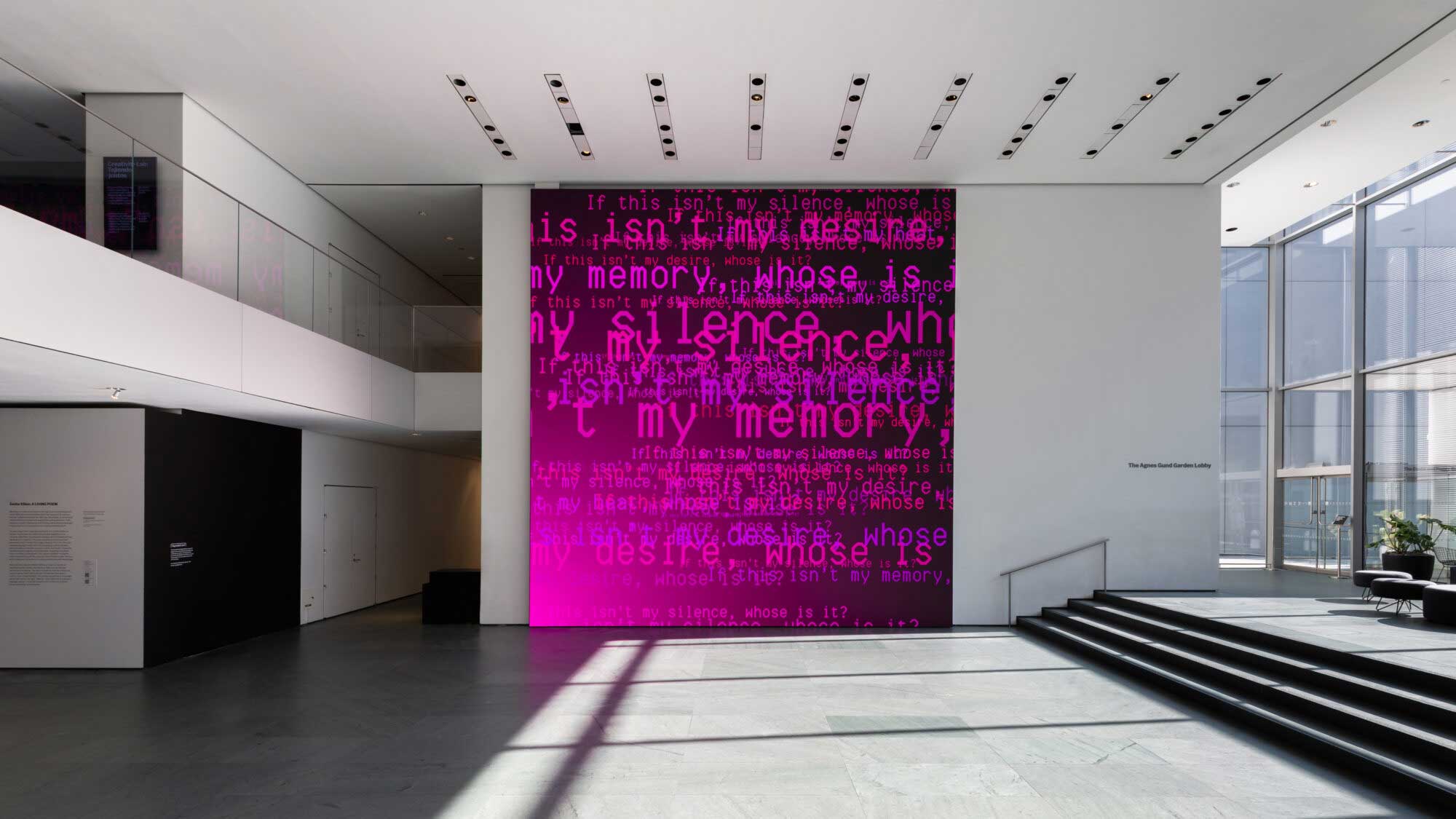
As promised, following my last article, I spoke with a few digital art world friends about their experiences in navigating social media for art. I first asked Sasha Stiles—via Instagram, no less—about her relationship with social media. This was particularly significant, as my own social feeds were inundated with her stunning exhibition at the MoMA. A Living Poem, on view at the museum’s atrium until Spring 2026, is easily my favourite digital artwork to grace that space. It is a poem that constantly rewrites itself, relying on an algorithm intended to function as a kind of digital copy, or perhaps ghost, of Stiles. The act of training an AI on oneself and asking it to write poems is, after all, beautifully poetic, and speaks volumes about the romantic possibilities of AI-generated works of art. Having left New York after being denied my own Green Card some time ago, my experience of A Living Poem was mediated entirely by Instagram, which was wonderful, because the online attention contributed to my enthusiasm, and the support and attention she was receiving was overwhelmingly positive. At the same time, I was deeply frustrated, because I was looking at a digital screen shrunk to 1/50th the size of the actual installation. Having also asked long time digital art patron and former Chair of the Board of Trustees at RISD, Michael Spalter, his thoughts on experiencing digital art in person versus via Instagram, I felt validated by his answer: "Social media shows you what it looks like. The room shows you what it does to you." Spalter’s position recognised the mediating effect social media had, and he differentiated between the physical and the social media experiences of an artwork as the difference between being altered, versus being informed. According to Spalter, context is the hidden medium. "[A] piece in situ–architecture, light leaks, ambient sound, crowd movement–becomes part of the composition… The hush of a gallery, the murmur of a museum, the ritual of showing up—all of it primes you to receive the work differently." But not all of Stiles’ works necessitated a physical experience. She emphasized that her work had to do with her relationship to technology, so social media was naturally a big part of it. "I started off posting my multimedia and conceptual poetry experiments on Instagram because I didn’t know how else to publish them. It became a kind of sketchbook or studio." I was hesitant about this approach, and whether it was possible to engage the work meaningfully via social media, even though I understood how it could allow poetry to exist without needing to be accumulated and published, which is the dominant methodology. 691 Stiles focused on the connections social media offered: "Because a lot of my work is media-rich and poetically intimate, [social media] can actually be a nice medium for it. There’s a kind of directness, a one on one connection. The work can find you at random moments, surprise you, come to you when you’re not expecting it but happen to need it.” While we often think about digital art in terms of digital visual art, the medium of NFTs and digital platforms themselves do enable other forms of art that would get lost in more analog settings to exist. For example, if it’s not written in neon, we tend to overlook poetry in South Beach. So this was a particularly interesting medium to investigate in terms of social media. After inquiring about Instagram, I naturally asked if X was different. "Twitter/X has always felt more conversational," she wrote, "a kind of decentralized global artist residency." While I do not consider myself a cynic, imagining X as an artist residency in any capacity is decidedly a stretch for me. But I do trust an artist who singlehandedly brought digital poetry back into our lives after Jenny Holzer. Perhaps this was less about objective reality and more about perspectives… a kind of intention-setting that defined the online experience. But the online experience isn’t only decided by the user. Spalter criticised the limitations of outlets such as Instagram, which often decide for the viewer the duration of the work. “Timing, drift, and randomness don’t translate to a 12-second clip.” he said, “Curatorial pacing, scale, and sequencing are editorial choices you can only fully grasp in the room.” My final question was: Is there an ideal way to experience digital art? Spalter had already answered the question, for him the ideal way was in situ. Stiles, ever the poet, simply said: “Yes — unhurriedly.”
The Perils of Digital Discourse
Can we talk about digital art without commerce?
Digital art has existed for nearly a century, but it didn’t really become part of our lives until the 2020s. Although we all knew of Rembrandt, Pollock, Warhol etc., there wasn’t a single digital artist who was a household name until extremely recently. Now, many people can comfortably mention names like Refik Anadol and BEEPLE, and even Sasha Stiles, PAK, and Operator, without having to think too hard. In many ways, today’s digital art market, and perhaps since I am excluding names like Vera Molnar and Aaron Cohen from this argument, I should call it the new digital art market, is quite nascent. A lot of its denizens are quite young, and are receiving tremendous exposure in spaces that perhaps do not have the infrastructure for meaningful critical discourse. What’s worse, fame and notoriety on X often fails to translate to the traditional art world, creating two parallel art markets. Social media does not quite function the way the physical world does when it comes to contemporary art, and the rules of the internet require a different set of skills than that of the physical. I often struggle with the fact that Twitter, or now X, is the primary space for conversations on, or about, digital art. It has been thoroughly distorted since Elon Musk’s acquisition in 2022, with the algorithm favouring a very specific set of linguistic signals and content. And yes, you could argue that the traditional art world has a liberal bent, but it doesn’t create literal hierarchies of attention the way algorithmic platforms do. The rules for art-world discourse and visibility on X are wildly different. Is being retweeted by an established artist the same as walking into a gallery opening as said artist’s plus one? Does a blue check translate to being on the guest list, even if you paid for it? The parallels, if they can be drawn, are messy (though anthropologically fascinating). One thing that I come back to often is the language requirements of digital environments, in which artists don’t need to have the vernacular to describe their practice, but they do need to talk within the parameters of the digital art world. To the moon, for example, a common rallying cry for many in the NFT space, is openly about the pursuit of wealth. An artist debuting a work of art with this rallying cry is certainly transparent about their priorities and aspirations. They are also less likely to gain traction with any collector or curator interested in deeper motivations. Unfortunately, digital culture does not allow most artists to simply unveil or exhibit, they have to operate within the parameters of the culture. This means artists on X "drop" their works, a word borrowed from streetwear culture that creates a sense of urgency with the intention of creating demand. A drop is inherently commercial, and while there is nothing wrong with that, when the online landscape requires you to create urgency around the work for it to make a statement, the way in which you might have spoken about it if you simply wanted it to exist, changes radically. The traditional world still views NFTs as largely hype over substance. Digital artists and their communities intentionally attempting to create hype around their work does not help. In fact, I can emphatically say, hype is not the path forward. An art gallery also functions as a commercial space, and can create some semblance of urgency to facilitate sales, but it still manages to host culturally meaningful conversations. But by that analogy, there is no museum space in the digital conversation sphere, where someone isn’t chiming in on a thread trying to peddle their wares, as it were. I suppose the point I am trying to make is, can artists present their works on digital platforms like X without the explicit, or implicit, commercial concern? Does it have to be one big grand bazaar, or is it possible for a museum-like digital space to exist within it? Where are the digital kunsthalles? Trolls in the Thread In the digital wild west, social contracts that govern us in physical environments are largely missing. This tends to dilute critical discourse. A digital commercial setting sometimes allows for interlopers. This is both good, and risky. Conversations are not streamlined and linear the way physical conversations are. Interactions are not finite, and so it is much more difficult to have contained, thoughtful discourse. This of course grants a kind of global accessibility to a conversation that in the physical world people might have missed out on. But a thread on X is often disjointed, cacophonic, can be interjected by tweets ranging from MAKE AMERICA GREAT AGAIN to Here’s how I lost 40lbs using this one clever trick doctors won’t tell you. Or worse, can be littered with trolls intentionally attempting to sabotage a conversation, for no reason other than the fact that we have collectively accepted agents of chaos as part of the digital ecosystem. Say what you will about gallery talks, no one turns into a walking billboard or prevents you from literally listening to the artist by grabbing a megaphone and going on a rant halfway through. The price of this no-gates policy, this flexibility, is navigating a space full of arguments, cynicism, ridicule, self-deprecating language, humour (as a defense mechanism), and anonymity. All of these are manageable if you know your way around social media, but do digital artists have to? When did we decide that digital artists have to either endure, or also be good at, shitposting? There is also something so profoundly performative about the culture of tweeting GM into the ether that is almost cult-like, like a bird call but only for a particular set of birds even though everyone can hear it. Whether or not it is actually an innocent and warm greeting intended to build community matters very little when it is attached to the same discourses that focus, overwhelmingly, on sales and wealth. As I mentioned earlier, the physical art world also has its spoken and unspoken rituals, coded language, and barriers to entry. But I’m concerned that in our quest to make everything and everyone so utterly accessible on social media, we have eroded some cultural safeguards and stripped some of these digital spaces of their possibility for meaningful discussion. The result has been a siloing off of the digital art world. Supported largely by the crypto-community, which the traditional art world avoids, digital artists still do not quite coexist with their traditional counterparts. As accessible as it is, the internet is also maze-like in the way it harbors communities, and social media rarely gives you exactly what you are looking for, instead offering you what it thinks you should look at. Most traditional curators, collectors, and artists, simply do not navigate the internet the same way digital artists do. I have no clue how to enter some of these conversations around digital art on X, despite being very much in it, and I can only imagine how difficult it must be for everyone else. For artists daring to venture into any social media beyond Instagram, there is also a language barrier that comes from the required performance of having to cynically put down your own practice before posting about it. The existence of algorithmic digital intermediaries, the extreme accessibility of conversations, the commercially-minded languages around digital art, as well as online culture in general, all contribute to the chasm between the traditional art world and digital art. So how do we bridge this divide? To answer this thorny question, I have decided to interview some friends on how they navigate the digital art world today. Stick around for The Cache № 8.
The Attention Trap
On the dangers of trading in online traffic & celebrity
During 2022, I interviewed the founders of several digital art platforms that were focusing on growing NFT culture and essentially recruiting artists to become crypto-artists. One such founder, whom I won’t name, said that their company’s curatorial approach hinged primarily on the artist having a large following on Instagram. This was, after all, a practical method that ensured investing time and money into artists posed less of a risk, since they came with a pre-built audience. This audience-centric, or perhaps audience-aware approach, is commonplace in the digital art space. A large digital following doesn’t just offer street cred, it implies commercial viability. It implies immediate market feedback. What it doesn’t guarantee is artistic and cultural value. We are all participants of, and complicit in, the attention economy. For millennia, artists were protected from an immediate, opinionated audience. As a result, their practice wasn’t subject to the daily commentary and validation–or rejection–of the masses. A solo exhibition, usually years apart, was a rare opportunity for an artist to receive critical and public feedback (and, hopefully, to sell). These prolonged periods between shows, between moments of visibility, meant the stakes were significantly higher, but they also granted the artist a greater degree of independence from the market and from public opinion, to create independently. As artists on social media, we no longer have that luxury. We are all participants of, and complicit in, the attention economy. The impact of this cultural shift has been tremendously destructive for contemporary art. Social media rewards consistency and persistence. These are valuable traits, sure, but they also punish creative risk taking. For example, an artist exploring something that is not strictly in line with their past work will usually be punished, in terms of audience engagement and visibility. I should be clear that when I say punish, I don’t mean in the vindictive, disciplinarian sense. I mean that you are simply shifted lower down in the timelines you would have been featured in. Social media algorithms also often favor commercial realities, meaning figurative works are rewarded over abstract ones, the use of warmer colours, such as red, might be rewarded (with attention) over the use of the colour blue, etc. Most social media platforms are not benevolent mechanisms that seek to promote art: their task is to promote whatever content keeps you on the platform, scrolling endlessly. So if an artist posts a work that might disrupt that flow, such as an artwork that diverges from their oeuvre, do you think they might be promoted as diligently? Because based on personal experience, I can tell you that the view and like counts of my artworks that are consistent with my past work, versus experimental posts, is staggering. And it’s not a question of the audience refusing the experiments, because these systems decide for them whether it is worth their attention. Another detrimental element of social media is the visibility of an artist’s following, which has an impact on their market viability. It would be reasonable to assume that today, some commercial galleries, much like NFT marketplaces, are aware of an artist’s pre-built audience on social media when considering them for a show or for representation. And while this enhanced, constant form of visibility may benefit some artists, to be discovered or to sustain their lives through a more continuous sales cycle, it does affect the creative cycle. TLDR: Measuring an artist’s cultural value by their social media footprint is a deeply problematic method for choosing the champions for digital art, because those engagements are fundamentally indicators of mass public appeal, not artistic prowess or creativity. E-Commercial Realities Another dangerous trend that I am observing within the digital landscape recently came in the form of a DM from a fellow artist several weeks ago. Referring to one of my previous Cache columns, this artist had provided a link to a site that demonstrated his NFT sale performance over the last few years. It was not a flex or a pitch, it was simply his preferred method for presenting himself as an artist. I recoiled, because for a traditional artist to directly submit this kind of information to anyone at all is anathema. The art world, whether you agree with it or not, does not want artists to be too involved in their own commercial reality. For any traditional artist to publicise their sales performance data let alone send it to people so directly is… unthinkable. The digital art market, in its quest for transparency, does the polar opposite, and plenty of digital artists openly share their market cap and past sales numbers of their works. While this may help combat speculative pricing and demonstrate investability, it does create an unhealthy environment in which nascent digital artists begin to equate their commercial success with artistic success. Sometimes, especially in the absence of critical discourse, this may be the only metric they have access to. But not all metrics are designed to be shared, let alone considered by the artists themselves when producing work. This can, and sometimes does, lead to artists allowing the numbers to determine the nature of their practice, because they instinctively pursue series that reward them financially and on social media. Naturally traditional galleries also pressure their artists to make more of particular series that sell, but within a digital landscape, the mass production element becomes corrosive much more quickly. There is no quick and dirty solution to this problem, but it does need to be talked about. Online celebrity, market impact, or the ability to make the algorithms favour you, should not be the arbiters of the next great digital artist. When we confuse digital fame and commercial success with cultural value, we can lose sight of art we should cultivate, and preserve.

The Water Cost of Big Tech
Technology can be thirsty. Some tech more than others.
As global warming continues to make summers unbearable, and New York City’s climate has recently been re-designated as "subtropical," the environmental impact of AI and the blockchain have once again become topics of discussion. According to Alex de Vries, founder of the Bitcoin Energy Consumption Index, in 2021 the CO2 emissions of Bitcoin was 65,4 million tonnes, roughly the equivalent of a mid-sized European country. What wasn’t addressed as much in mainstream news was the water cost, which was 1.57 billion litres, which amounts to nearly 700 Olympic-sized swimming pools. Today, that number is 2.3 billion litres, and the total water consumption of cryptocurrencies that require proof-of-work, i.e. more computing, is 3.7 billion litres. Proof-of-stake chains like Ethereum are fundamentally less thirsty, but a single Bitcoin-based transaction consumes around 16,000 to 22,000 litres of water. In comparison, AI data centres around the world are consuming an estimated 560 billion litres of water per year, which is equivalent to roughly half the amount of water in Lake Annecy in France (so many, many more pools).While it is safe to say that compared to cryptocurrency, AI is the leading consumer of water, when it comes to individual transactions or processes, such as a single NFT sale versus a ChatGPT query, things are slightly different. Lake Annecy, Image: golibo, Getty Images A single AI query on ChatGPT consumes between 0,32 and 25 millilitres. Granted, we often use AI for an entire conversation, rather than a single question, but even if we were to multiply that number by 10, or 100, we would still be several orders of magnitude below the water consumption of blockchain transactions. You could think of it as a shot glass of water versus a swimming pool. This is a crucial difference, because it changes consumer culpability. A single person engaging in speculative trading for a week on the blockchain, will in all likelihood consume more water than one person having a philosophical debate with ChatGPT over the course of an entire year. And yet, we do not hold individual crypto traders and NFT holders in our lives nearly as accountable for their environmental impact as we do those who engage in/with AI. A surprisingly high number of people continue to flood my DMs with mentions of how much water is consumed every time someone makes a query with ChatGPT. As an artist working with AI, it has become one of the first criticisms people launch at me, even before they see the work. I certainly do not dismiss that AI, especially on a corporate level, can be a thirsty beast. But the art world has been a big water consumer for a long, long time. From collectors flying on private jets, to the cost of shipping artworks across continents; from the environmental impact of sourcing materials for producing sculptures, producing paint, developing film photographs etc., to erecting temporary exhibition spaces, there are many elements of the art world that require large quantities of water. The Venice Biennale might have achieved carbon neutrality in 2022, but CO2 emissions and water consumption are entirely different things. Still, lowering CO2 emissions includes managing logistics to be more efficient, which means it is reasonable to assume a positive impact on water consumption. But, even if an institution is environmentally-conscious, art world patrons are often luxury travelers with big environmental footprints. A private mid-sized jet flight consumes roughly 800 gallons of water for a two-hour flight, and there are nearly 10,000 private flights taken every day. Annually, this adds up to 15.3 billion litres. According to The Guardian, around 250,000 people fly private every year, and most are repeat fliers. This means that the average annual water cost per private jet user is about 61,200 litres. Broken down per flight, the water cost is roughly 4,286 litres. For example, in 2023, Kim Kardashian consumed approximately 707,000 litres across her 165 private flights as reported by Ashley Pomplas of The Post Athens, making her the single global leader in individual water consumption. To reach her level of water consumption, an individual would have to make 37 NFT transactions, or generate 55,9 million individual queries on ChatGPT, which, even at 1 query per second, is physically impossible. In other words, if you release an NFT collection with 40 artworks and you sell out, you have just spent as much water as a celebrity flying on a private jet nearly every other day. So now at least, we have a fascinating exchange rate for what our individual actions cost in terms of water. Of course, this is not a perfect comparison. In fact, there are countless other industries whose water consumption could be included in this article. But, in the messy, messy Venn diagram of art, technology, and luxury, private flights consume significantly more water than public AI tools like ChatGPT on an individual level. Now, when we zoom out, global data centers do consume significantly more water, around 4-6 trillion litres to be exact. This easily exceeds global aviation, at 40-60 billion litres. I am simply emphasising that hating on OpenAI and holding your friends accountable for global warming would have less impact than asking Kim Kardashian to fly commercial for a year. As the anti-AI sentiment continues to surge through social media, and people seek new scapegoats to blame for the excruciating heat waves passing through the Northern hemisphere, it is vital that we take a moment to ensure our outrage is not purely reactionary and ill-researched. Important note: Most of the math in this article is very, very rough. I am not a statistician and I barely survived high school trigonometry, but the numbers are publicly available for anyone interested. I am more interested in fairness, accountability, and strongly welcome (even encourage) everyone to do their own research before hating on AI.
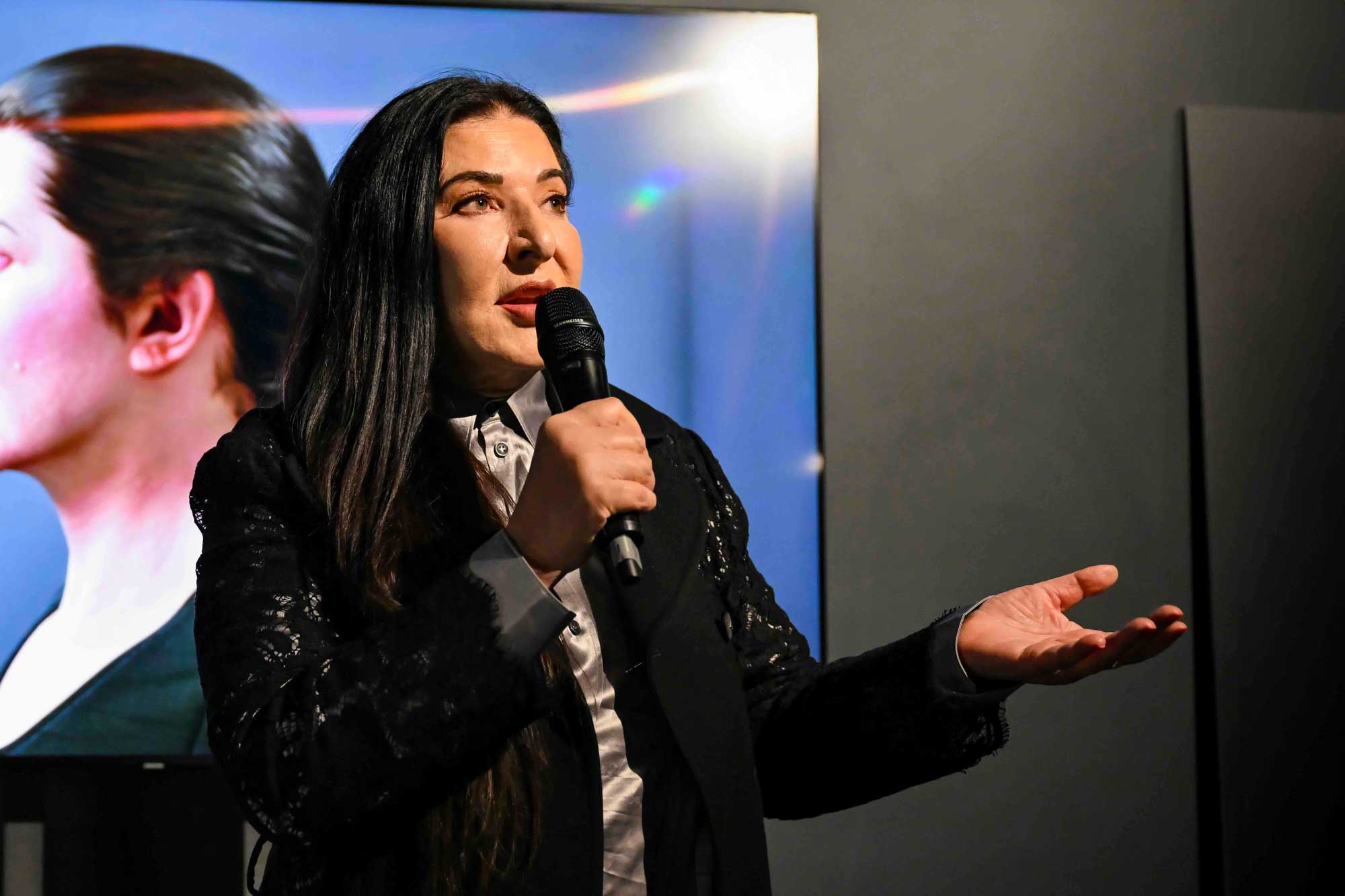
In-Conversation with Marina Abramović
On June 12 TAEX and MAE hosted a special livestream with Marina Abramović.
In a special conversation led by Stefanie De Regel and featuring questions from web 3 icons such as SeedPhrase, Natalie Stone, Justin Gilyani, and ALIENQUEEN, things got truly transformational, symbolic, and a bit emotional. Here are our highlights from this deep conversation. Acronyms: S - Stefanie De Regel MA - Marina Abramović S: Marina, welcome. It’s very nice to see you today. Could you tell us a bit more about what excited you about creating an avatar and why you decided to embark on this journey? MA: First of all, I wake up in the morning and I try to see the world with new eyes, like a child. I’m curious about everything that is going on. Of course, technology, artificial intelligence, all the new things we have now in our human life interest me. I come from a generation of fax, Xerox, telegram. We didn’t have computers, we didn’t have mobile phones. The revolution is incredible. Of course it’s interesting. And of course, as an artist, I want to know more and work with this material. S: We are going live next week, on the 18th of June. We’ll be showing the first chapter of the project, which is called ART. What specifically excites you about this release and the performances we’re showing? MA: The first thing about this collection is that I am learning. It’s like being a pioneer, like taking the first step, or learning to walk. I have to learn about technology. I remember getting my first computer—you have to learn the language of the computer to understand it. I come from performance art, and when you do performance, you have to learn the language of performance. But also, the public has to learn to understand what they are looking at and how to perceive it. It’s the same with this technology. So I’ve learned things, and I’m very interested in using my knowledge of performance and transforming it into the ideas of the avatar—in a new and fresh way. Very interesting. So I’m very excited. It’s a new medium for me. S: I remember when we were all brainstorming together about the age the avatar would have, and we asked you this question. You surprised all of us because we thought you were going to go for a very young avatar. But then you said it was going to be 60 years old. Could you explain why you made that choice? MA: Oh, it was very important. I really felt I would never like to go back to my twenties, thirties, forties, or fifties. I was miserable. I didn’t know much about the world, and I made the same mistakes over and over again. There was a lot of suffering. But one thing about old age is that you gain wisdom. And wisdom is something so precious. Now, I am not 60—I’m getting close to 80 next year—but I felt 60 was the right age for the avatar. S: As announced today, we have some guest speakers. I would love for them to ask you questions. The first one will be SeedPhrase, a major collector of digital art, a curator. I’ll give the stage to Seed Phrase now. SEEDPHRASE: My question is: much of your work explores the limits of presence, vulnerability, and endurance in the physical space. How do you translate these deeply embodied experiences into the intangible digital worlds of NFTs without losing the emotional intensity? MA: You have to approach it from a completely different angle. Everybody was thinking, “Okay, how can you make performance work in the digital world?” You know what? You can’t—because it’s a different medium. You have to apply different rules. You have to understand what is good and what is bad about this medium, and how you can translate it into something else and deliver a new message. So my message to the avatar and to the digital world is: slow down. Because everything is so fast. Time is moving differently now. It’s going to be a different way of seeing performance, a different way of interacting. It’s not me doing something—it’s you doing something with yourself. It’s a totally different approach, a different angle on how to deal with it. I’m using this new medium as a tool to approach performance in a new way and to teach participants in this medium to create a different sense of time and a different sense of presence. This is the core of my work. If you look at how kids play video games, it’s super fast—everything happens instantly. One kid never watches television without zipping through programs a million times. Their concentration is zero. If you work with me and engage with the work I’m giving to you, it’s the opposite. You have to start breathing. You have to sit down. You have to forget about time if you want to experience it. And that is the core of performance. It’s not about me being present—it’s about them being present in themselves. The only way to change the world is to change yourself. It’s a kind of pioneer work. And if I can change three people out of millions in the audience, that’s already an achievement. SEEDPHRASE: Great answer. I really love this because you’re also tapping into an entirely new audience, and creating this sense of timelessness with your performance. MA: And you know, what’s interesting is that I have a huge amount of young audience, which I’m so grateful for. But young people—yes, they come to see my performance, and then they go play video games or work with technology, and everything is too fast. So I want to get closer to them, to actually point out things that can change. The only way to change the world is to change yourself. It’s a kind of pioneer work. And if I can change three people out of millions in the audience, that’s already an achievement. S: Thank you, SeedPhrase, for your wonderful question. And thank you for being here! Now, the next question comes from a very interesting individual. Her name is Natalie Stone. She was the former general manager of CryptoPunks NFT, and she’s a bridge builder. She’s a major figure in tech and has been very excited to speak with you, Marina. So I’ll leave the stage to her to ask the question. NATALIE STONE: I’m almost overcome with emotion because it’s such an honour to be asking you a question in this format. You’ve spent decades using your body to create empathy between strangers, but you’ve also explored the capacity for cruelty in humanity. So with your avatar, are you teaching technology to be empathetic, or are you finding new ways to cultivate empathy through technology? Think about: who are we? What are we doing on this planet? What is our purpose? Where does life come from? There are so many questions we always avoid answering. So my role here is to use technology as a tool to bring the public back to themselves. MA: I am teaching technology. Technology was invented to give human beings more time—but we don’t know what to do with that time. Because we’re addicted by nature. We want more technology, more advancements, and then we end up having no time. And then comes depression, burnout, and all the other symptoms of technological overdose. At first, I had a love-hate relationship with technology. But now, I really think it has so much quality. It can help people in so many ways. Still, we must learn to have moments in our lives to detox from technology. Moments when we switch everything off, sit in silence—somewhere quiet, at home or in a garden—and just think. Think about: who are we? What are we doing on this planet? What is our purpose? Where does life come from? There are so many questions we always avoid answering. So my role here is to use technology as a tool to bring the public back to themselves. One of the duties of the artist is to offer some kind of guidance. It’s not about solving the world’s problems or asking all the questions—but at the very least, we can show some paths that might work. NATALIE STONE: That’s so beautiful. As the avatar and project are in development, how do you see it evolving as you start to uncover its potential—like, as you say, maybe even standing still? MA: You know, the possibilities are incredible and enormous. Technology is changing daily—even as we speak. Every day, you open the news and something new has come. There is so much to learn. I’m a beginner, learning all of this, but I believe the possibilities are endless. Artificial intelligence is another incredible subject. I recently had an interview in London with Hans Ulrich Obrist, who actually interviewed my artificial intelligence version. It was incredible what she said. She knew all the knowledge—every text, every interview I’ve ever done—and she expressed it in a way I could never have done myself. I said, “Wow.” That’s another level. So how far can we allow or permit artificial intelligence to influence us? These are questions we’re now asking. What was science fiction in the seventies and eighties is reality today. When you read science fiction now—it’s already happening. Who will rule the world? Will it be robots? That’s a very big question. How can we control this? How can we understand what’s happening? I think the answer lies in going back, in some ways—back to simplicity—and in having a healthy relationship with technology. Because right now, we don’t have one. One of the duties of the artist is to offer some kind of guidance. It’s not about solving the world’s problems or asking all the questions—but at the very least, we can show some paths that might work. S: Thank you so much, Natalie. It was lovely having you. Marina, do you remember your very first encounter with technology? How old were you? MA: My first real experience with technology was getting a television. I think I was about fifteen, and my brother was nine. In our family, we had never had a television before. We were in Yugoslavia, during communist times. Then this big box arrived—our first television. When you turned it on, all you could see was text and pictures, nothing else. In the evening, there were three programs, mostly war movies. The rest of the time, it was a test picture. I remember my brother and I sitting in front of that test picture, just staring at it—completely hypnotised. I think that was also my first encounter with meditation. And then, I was even more fascinated by the snow—the visual noise on the screen when the television wasn’t working. That snow looked to me like energy particles. I imagined it was another planet, in another galaxy, visiting our world, and that these beings were going to step out of the television and into our space. It was incredible. S: When we see the avatar, and when we reveal the collection next week, it will be very exciting to see the textures, the structures, the colours, and the emotional effect it has. From the previews we’ve shown worldwide, when people see your avatar—the 60-year-old Marina—and see the scorpion, it’s very transcendent. It’s hypnotic. It is you, and yet it’s a different digital entity. But the emotion it gives is real. That’s what I find fascinating—just like when you watch a powerful movie. What are your thoughts about that? MA: Can you imagine? I’m just thinking—this avatar is still in its beginning form. Now it’s 2025, and we’re launching it on the 18th of June—in just a few days. But imagine how technology will look in 2030. This avatar has the potential to become better and better. It could eventually turn into a fully functioning robot—an actual robot with its own artificial intelligence. What fascinates me is the growth potential of this avatar in the future. S: Lovely. So, we’ll go to the next person who has a question, Justin, who is also a curator. He has a very exciting question for you—I’ve had a little sneak peek. JUSTIN GILYANI: How do you see the medium shaping the role of the witness? Whether it’s a collector or someone simply participating—how do they become part of it? How do you see yourself as a custodian of performance? MA: When I made my performance The Artist Is Present at MoMA, I sat there for three months—eight hours a day, ten hours on Fridays when the museum stayed open later. It was one of the most demanding works of my life. When I finally stood up from that chair, I realised something very important. In the 21st century, museums—and the public that visits them—can no longer just come and look at something. They’re bored. The artist and the audience need to be part of something on a much larger scale. That’s why I opened my institute and started working with audiences in a new way. I made a very important declaration: the audience is my public. The audience must learn to perform and have their own personal experience. My entire body of work has been focused on that idea. There was 512 Hours, a show with full public participation. Then at the Glastonbury Festival, I asked 275,000 people to be silent for seven minutes. It was about full-scale collective participation. And now, on an even larger scale, we’re doing this with the avatar and with new media. The question is: how can I reach a huge public using technology as a tool to share my message? And my message is very simple—slow time down. Make contact with yourself. And by changing yourself, you can change others. That’s it. JUSTIN GILYANI: I think that’s such an important idea right now—to really slow down. And I find it fascinating that we can actually use technology like this to do that. It’s interesting to think about, because historically, you’ve always pressed the limits of your body. You’ve placed yourself in extreme situations through your performance pieces. But this piece—the avatar—will live on beyond death, beyond the physical. How is that for you? I find it very exciting because I’ve always loved performance art, but it has a beginning and an end. This will continue to evolve. How does it feel for you, as a practitioner, to think about your work extending beyond the physicality of your body? MA: That is exactly the point. You have touched on exactly where my interest lies. All of us are born, we grow, we get old, and then we die. That is how life works—for humans, animals, plants, trees. It is the same story. And now, I am approaching my eighties. I don’t know how much longer I can physically perform. There will come a point when I can’t. But that doesn’t mean the performance has to die. That is the incredible opportunity of the avatar—to go beyond that into immortality. The avatar can carry on the message. It can carry on the knowledge. That’s also why I chose to make the avatar 60 years old—because by then, you have wisdom. JUSTIN GILYANI: I want to thank you. In a world that’s so overwhelmed with noise and distractions, art for me is a sanctuary—it is transcendence. And for you to use your body and your practice as your expression—it’s one of the purest forms of art. For anyone listening today, I hope they realise this is a real moment in time, where art and tech and everything human can come together and truly blossom. So, thank you for that. You gave me goosebumps when you shared that. I look forward to being on this journey and witnessing it—as an audience member, as a collector, and as a participant. MA: Thank you very much. STEPHANIE: Thank you. That was a wonderful interaction. Now, the last question is coming from ALIENQUEEN, who’s an artist. ALIENQUEEN: Thank you. I am so honoured to be here. As an artist, you have been such an inspiration to me. I have read your autobiography—I’m very emotional right now. Just to have this privilege to speak to you means so much. I’ll get to my question. You’ve done some of the most memorable performance art—my favourites are Rhythm 0 and The Artist Is Present. My question is: what is the one thing you would do in the fifth dimension that you almost did in real life? What’s the wildest thing you’ll do in the fifth dimension? MA: Everything I couldn’t physically do. That’s what the fifth dimension is for. It’s a dream dimension. You can fly. Walk on fire. Levitate. Travel to different spaces. Go beyond our galaxy. Maybe even land on Mars. All of that. It’s such an opportunity. It’s like your childhood dream world opens up to you—with endless possibilities. And I want to take the public, the viewers, into that kind of world too. And one important thing: it’s a world I want to take them to without viruses, without greed, without brutality, without war, without pain. Because all around us right now, we’re living through an extremely difficult moment in human history. I think we need that other world. You know, when Matisse was painting during the Second World War, when everyone else was painting the horrors and atrocities of war, he spent those four years painting only flowers. And only once I gained wisdom did I truly understand what that meant. Because we need to be surrounded by beauty, peace, and harmony—not more reflections of horror. What’s happening is already disturbing enough. We need the opposite world. I want to create a world of beauty, harmony, peace—and a world where we really slow time down. S: That’s amazing! Thank you so much. It’s very touching to hear your knowledge of Marina’s work and your enthusiasm. We’re so happy to see that the Web3 and digital art communities are so well acquainted with Marina’s practice—and so excited. I would also like to thank all our guest speakers. Marina, thank you so much for today, for the wonderful answers. Thank you to everyone watching from around the world. It’s been great to have you. MA: Thank you so much. Thank you, everybody. To view the full video of the livestream follow the link to the MAE X account.
Stay Tuned
Be the first to learn about new collections, events, and more.