Art Basel Hong Kong
March 25, 2026 — March 29, 2026
Hong Kong, Booth Z8, Zero 10, Hong Kong Convention and Exhibition Centre (HKCEC)
TAEX is delighted to premier Testing Ground—a new series of moving and still works by the renowned artist Kevin Abosch—at Art Basel Zero 10 in Hong Kong.
Testing Ground approaches landscape as an experimental site: an environmental laboratory where resources, materials, perceptions, and computational processes converge. These works do not depict fixed locations; instead, they unfold within a hybrid terrain constructed from layers of memory, inference, and design. Each image behaves like a testing surface, offering a place where new relationships with the environment can be examined, adjusted, and imagined.
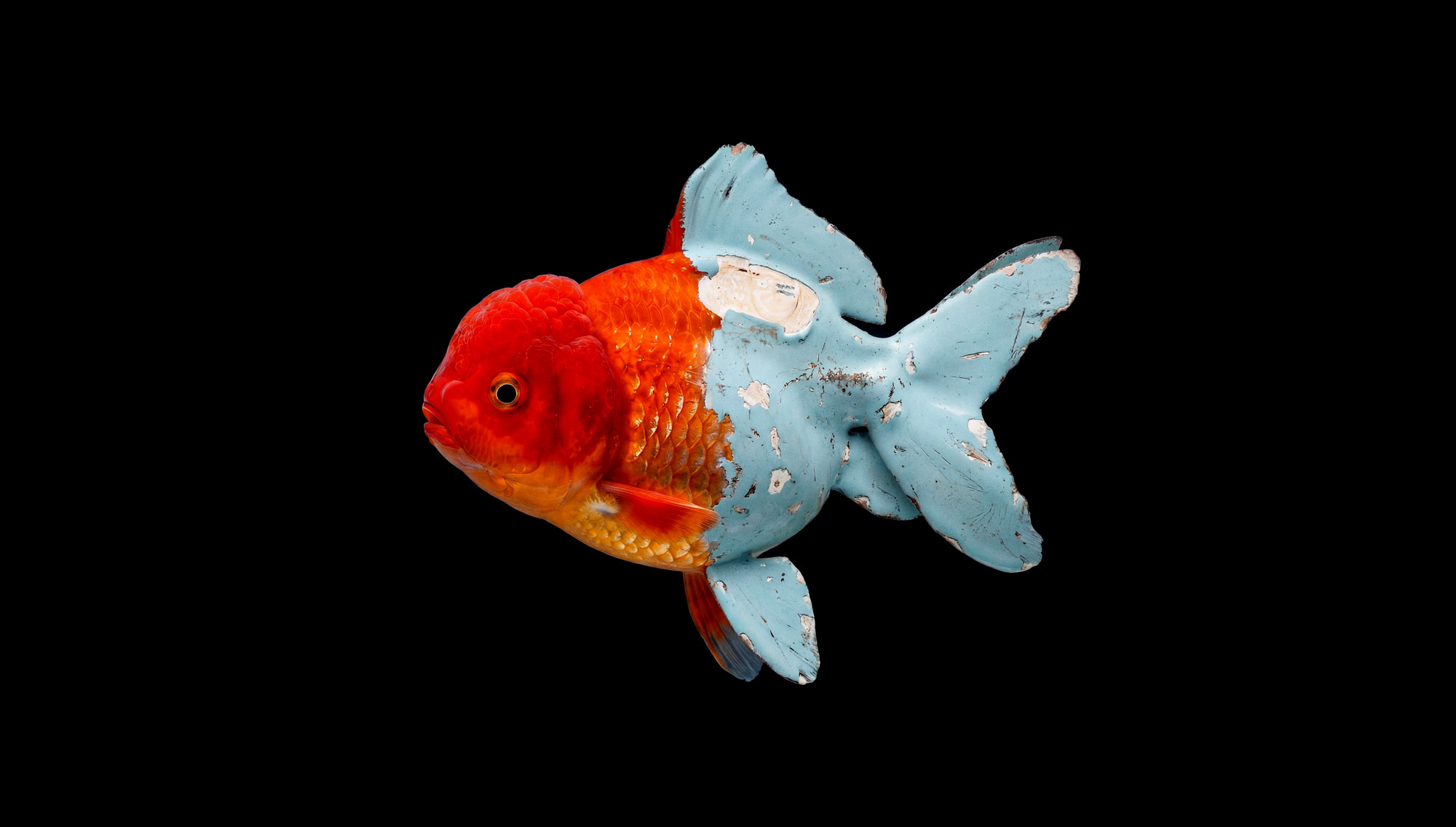
Within this framework, Goldfish presents a familiar ornamental species as a constructed environment in miniature. The body appears partially infrastructural, interwoven with a hardened, enamelled surface that shows visible wear and abrasion. The coating is not pristine; it bears traces of exposure and contact, suggesting duration rather than fabrication alone. Scales and enamel, fluidity and rigidity, living tissue and weathered finish coexist within a single form, dissolving any stable distinction between organism and object.
Seen in relation to Testing Ground, the goldfish becomes less an image of nature and more a site of convergence. As a species historically shaped through human selection and sustained within artificial habitats, it already embodies a reciprocal relationship between environment and design. Here, that reciprocity is made visible: the body reads as both life-form and substrate, both inhabitant and surface. The work treats landscape not as external scenery but as something internalised within form. The fish becomes a testing surface where natural and synthetic processes operate in tandem, each influencing the other’s configuration.
The series grows out of an extended practice of guiding generative systems through cycles of iteration and refinement. Inputs shift, parameters adjust, and the system responds within defined boundaries, revealing configurations that develop through this structured exchange. This reciprocal process echoes the way we continually shape our environments while those environments, in turn, develop their own patterns and tendencies.
In this sense, each work becomes a field study: both the outcome of deliberate observation and a platform for ongoing inquiry. Central to the project is the idea of “ground” as a multilayered substrate. It refers simultaneously to physical terrain, to the surface that receives and holds an image, and to the computational base layer from which synthetic forms arise. These layers overlap and interact, creating conditions in which natural and artificial elements operate together as active contributors within a shared experimental ecology.
Viewed this way, landscape becomes a tool for thinking. The works propose spaces that are structured yet open, familiar yet reconfigured, inviting viewers to consider how environments participate in our evolving sense of orientation, imagination, and possibility—and how our shaping impulses meet the environment’s own generative capacities.
Kevin Abosch (born 1969) is an Irish conceptual artist widely regarded as a pioneer of digital and AI-driven art. Working across photography, blockchain systems, and machine learning, he has spent more than three decades shaping how artificial intelligence and synthetic imagery are understood within contemporary practice. His work interrogates identity, authorship, and value, engaging with the philosophical and societal implications of technological change.
Abosch began creating AI-based artworks as early as 1992, placing him among the first artists to work seriously with artificial intelligence in a fine art context. He is frequently described as one of the earliest practitioners of synthetic imagery and is distinguished by the rare combination of being both a rigorous conceptual artist and a committed technologist—a position that sets him apart even from earlier generations of generative artists.
He first gained international attention through his Potato series (2010–2016), in which a single potato was presented with the gravity of classical portraiture. One work from the series was sold into a private collection for over US$1 million, sparking debate about value, scarcity, and authorship in contemporary art.
From the mid-2010s, Abosch integrated generative adversarial networks (GANs), biometric data, and blockchain systems into his practice, treating machine learning as a creative collaborator. Works such as IAMA Coin (2018) explored identity as both technological and economic construct, and his AI-based projects are regarded as milestones in the development of the genre.
In 2024, he directed Am I?, widely recognised as the world’s first feature-length film generated entirely using artificial intelligence.
His work has been exhibited at major institutions including the State Hermitage Museum, St Petersburg (2018); the National Museum of China, Beijing (2017); Red Brick Art Museum, Beijing (2018); the National Gallery of Ireland, Dublin (2015); Jeu de Paume, Paris (2016); the Irish Museum of Modern Art, Dublin (2013); the Bogotá Museum of Modern Art (2014); and ZKM | Centre for Art and Media Karlsruhe (2019). His practice remains a key reference point in the emergence of AI-based art.
Opening Hours
VIP Days (by invitation only):
First Choice | Wednesday, March 25, 12 noon to 8pm
First Choice and Preview | Wednesday, March 25, 3pm to 8pm
First Choice and Preview | Thursday, March 26, 12 noon to 4pm
First Choice and Preview | Friday, March 27, 12 noon to 2pm
First Choice and Preview | Saturday, March 28, 12 noon to 2pm
First Choice and Preview | Sunday, March 29, 11am to 12 noon
Vernissage
Thursday, March 26, 4pm to 8pm
Public Days
Friday, March 27, 2pm to 8pm
Saturday, March 28, 2pm to 8pm
Sunday, March 29, 12 noon to 6pm
OPENING TIMES:
25 March - 29 March Wednesday to Sunday 9:00 am - 3:00 pm
ADMISSION:
Ticket or Invitation Required
PRESS CONTACT:
pr@taex.comExhibiting ARTWORKS
Stay Tuned
Be the first to learn about new collections, events, and more.